
Meera closed her laptop at 1:30 a.m. in Pune and smiled.
Her company, a product startup with forty people, had just signed its first major US customer. The call had gone perfectly. The customer had one request: “We’d love a point of contact in our time zone.”
Meera already knew who she wanted. Jordan, a customer success leader based in Austin, Texas, had been a fan of the product for months and had made it clear he’d love to join.
There was just one question Meera couldn’t answer: How does a company in India hire someone in the United States?
Meera and Jordan are fictional, but their story is the first chapter for many global companies entering the US.
Why Companies Hire in the USA
Meera’s reason was customer proximity. For most companies, the first US hire comes down to one of these:
- Customer proximity. Sales, customer success and account management roles work best close to customers and in their time zones.
- Specialist talent. The US offers deep expertise in technology, finance, life sciences and many other fields.
- Market credibility. A local team signals commitment to US customers, partners and investors.
- Time-zone coverage. A US presence extends your working day for global customers.
Your Three Options to Hire Employees in the USA from Abroad
The next morning, Meera called her co-founder and her company’s accountant. Together, they mapped out three paths:
Option 1: Set up a US entity
Incorporate a US company, obtain an Employer Identification Number (EIN), register as an employer in each state where employees work, open a US bank account, and set up payroll, benefits and insurance.
It gives full control and makes sense for a large, long-term US presence. But for one employee, it meant time, ongoing administration and US legal, tax and accounting support. “We’d be building a company to employ one person,” her co-founder said.
Option 2: Use an Employer of Record (EOR)
An Employer of Record legally employs your US team on your behalf. You choose the people and direct their work; the EOR handles the employment structure, payroll, tax and compliance. You can hire quickly without creating a US entity. If you’re new to the model, read our guide to what an Employer of Record is and how it works.
Option 3: Engage independent contractors
Jordan could invoice as a contractor. It sounded simple, until the accountant asked a few questions. Would Jordan work full-time? On the company’s schedule? Reporting to Meera? Yes, yes and yes.
US authorities look at how a relationship actually works, not what the contract says. Federal tests apply, and some states, such as California, apply stricter tests of their own. Misclassifying an employee as a contractor can lead to back taxes, penalties and wage claims.
Meera chose the Employer of Record. But she still wanted to understand what was happening behind the scenes. Here’s what she learned.
Federal Employment Requirements in the USA
Whoever is the legal employer, whether your own entity or an EOR, must meet a set of nationwide federal requirements:
- Employer Identification Number (EIN): The employer needs an EIN from the IRS to report taxes and run payroll.
- Form I-9 (Employment Eligibility Verification): Every new employee must complete Section 1 of Form I-9 no later than their first day of work for pay. The employer must review the employee’s documents and complete Section 2 within three business days of that first day.
- E-Verify: An online system that confirms employment eligibility. Voluntary for many employers, but required for certain federal contractors and mandated by specific states.
- Form W-4 and federal tax withholding: Employees complete Form W-4 so the employer can withhold the correct federal income tax from their pay.
- Federal payroll taxes: The employer withholds the employee’s share of Social Security and Medicare taxes (FICA), pays a matching employer share, and pays federal unemployment tax (FUTA).
- New hire reporting: Federal law requires employers to report new and rehired employees to the state where they work within 20 days of hire (some states set even shorter deadlines).
- Wage and hour rules: The Fair Labor Standards Act (FLSA) sets the federal minimum wage and overtime rules, and determines which roles are exempt from overtime.
- Anti-discrimination and workplace requirements: Federal laws prohibit discrimination in hiring and employment, and employers must display required workplace notices.
- Year-end reporting: Employers issue Form W-2 to each employee and file the related returns after the year ends.
The State Layer: Where Most of the Complexity Lives
Six months later, the business was growing and Meera wanted a second US hire: a solutions engineer named Sam. Sam lived in California.
That’s when Meera learned the most important lesson about hiring in America: It isn’t like hiring in one country. It’s closer to hiring in fifty. Jordan in Texas and Sam in California would work for the same company, in similar roles, under different rules.
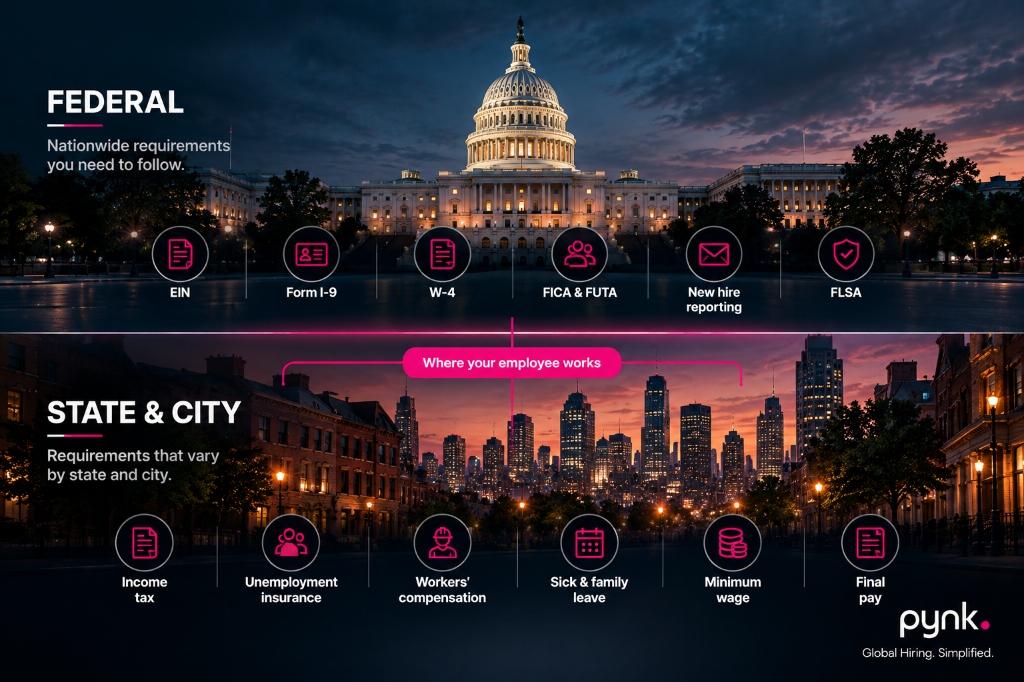
The state where an employee works, and sometimes the city, shapes many of your obligations:
- State income tax: Most states levy income tax; a handful (like Texas and Florida) do not.
- State unemployment insurance: Employers register and pay contributions in the employee’s state.
- Workers’ compensation insurance: Generally required, with rules and coverage set at state level.
- Paid sick leave and paid family leave: A growing number of states and cities mandate these.
- Minimum wage: Often significantly higher than the federal level.
- Final pay rules: Deadlines for the last paycheck vary widely by state (e.g., immediate payment upon termination in California).
- Pay transparency: Some states require salary ranges in job postings.
- Non-compete agreements: Enforceability varies, and states like California restrict them heavily.
For remote employees, the general rule is that the laws of the state where the employee physically works apply, even if your US office, or your EOR, is elsewhere.
Hiring in a specific state? Talk to Pynk and we can map out what applies before you make an offer.
At-Will Employment and Its Limits
Meera had heard that US employment is “at will,” meaning either party can generally end it at any time, with or without notice. That’s broadly true, but it isn’t unlimited.
Terminations cannot be discriminatory or retaliatory, employment contracts can add protections, and Montana is a notable exception that requires good cause after a probationary period. International companies should not assume their home-country termination processes translate directly to the US.
Benefits: What US Candidates Expect
When Meera drafted Jordan’s offer, salary was the easy part. Benefits were where she nearly lost him.
For most employers, US federal law does not require paid vacation, and larger employers face Affordable Care Act obligations around health coverage. But what the law requires and what candidates expect are different things. US candidates commonly expect:
- Employer-sponsored health insurance (medical, dental, vision)
- A retirement savings plan, such as a 401(k)
- Paid time off (PTO) and paid holidays
- Life and disability insurance in many professional roles
Competitive benefits often decide whether a strong candidate accepts your offer, so plan for them from the start.
Hiring US Talent from Abroad: Work Authorization
Everyone you employ in the US must be authorized to work there, and that is verified through Form I-9. When you hire US talent from abroad through an Employer of Record, you are hiring people who already have the right to work in the US, such as citizens and permanent residents. Jordan and Sam both qualified.
Relocating an employee from another country to the US is a different matter. It requires an appropriate US work visa, which is a separate, immigration-led process. Visa options, timelines and costs change frequently, so take specialist immigration advice before you plan a relocation.
Step-by-Step: How to Hire Your First US Employee Without an Entity
Looking back, Meera summed up her journey in eight steps. If you’re about to make your first US hire, start here:
- Define the role and location. Confirm the state (and city) where the employee will work, because it drives many obligations.
- Benchmark compensation and benefits. US pay varies significantly by location and role.
- Classify the role correctly. Decide whether the role is exempt or non-exempt from overtime, and make sure it is truly employment rather than contracting.
- Engage your Employer of Record. Your EOR becomes the legal employer and sets up the compliant employment structure.
- Issue a compliant offer and employment agreement. Include at-will language where appropriate, confidentiality and IP assignment, and state-specific terms.
- Complete onboarding. Form I-9, Form W-4, state forms, new hire reporting and benefits enrollment.
- Run payroll and stay compliant. Federal and state withholding, filings and ongoing changes. For the bigger picture across countries, see our guide to international payroll and tax compliance.
- Plan for growth. As your US team grows, review whether and when your own entity makes sense.

Common Mistakes When Hiring in the USA
Meera avoided most of these. Many first-time US employers don’t:
- Treating the US as a single jurisdiction and overlooking state rules
- Engaging contractors for roles that are really employment
- Missing the Form I-9 deadline (Section 2 within 3 business days)
- Underestimating the importance of health and 401(k) benefits to US candidates
- Copying home-country employment contracts into a US context
- Assuming non-compete clauses will be enforceable everywhere
Jordan’s First Day
Jordan started on a Monday. His customer had a dedicated contact in their time zone by Tuesday. And Meera, half a world away in Pune, finally got to sleep through the night.
How Pynk Helps You Hire in the USA Without a US Entity
With Pynk, you can hire employees in the USA without setting up your own legal entity. Pynk manages the employment structure, the legal requirements and employment compliance on your behalf, so your US team is employed correctly from day one.
We are your single point of contact for the whole journey: compliant offer letters and employment agreements, onboarding, payroll and tax, state-level obligations and offboarding. You focus on choosing great people and growing your US business; we take care of the employment.
And because US rules change at federal, state and city level, we work predictively, flagging changes early so you can plan rather than react.
Frequently Asked Questions
Can a foreign company hire employees in the USA without a US entity?
Yes. Through an Employer of Record, a foreign company can hire employees in the USA without forming a US entity. The EOR becomes the legal employer and manages payroll, tax and compliance.
Do I need an EIN to hire employees in the USA?
The legal employer needs an EIN. If you hire through an Employer of Record, the EOR acts as the employer, so you don’t need to set up your own US employer registrations.
Can I hire US talent from abroad as contractors?
You can if the work is genuinely independent. But if the relationship looks like employment under federal or state tests, misclassification can lead to back taxes, penalties and wage claims.
Which state’s laws apply to a remote US employee?
Generally, the laws of the state where the employee physically works apply, including tax, leave, minimum wage and final pay rules.
How long does it take to hire an employee in the USA through an EOR?
It depends on the candidate’s availability and onboarding steps, but it is typically much faster than setting up your own US entity.
Can I relocate an employee from abroad to the US through an EOR?
The employee must first hold valid US work authorization, which requires a separate immigration process. Talk to us about your situation and we’ll help you understand the employment side of the move.
What is the difference between a W-2 employee and a 1099 contractor?
A W-2 employee is on the employer’s payroll, with taxes withheld and employment protections. A 1099 contractor runs their own business, invoices for services and handles their own taxes. Which one someone is depends on how the relationship actually works, not on the label.
What is the difference between exempt and non-exempt employees?
Under the Fair Labor Standards Act, non-exempt employees are entitled to overtime pay. Exempt employees are not, but only if their role meets specific salary and job-duties tests. Classifying a role as exempt when it doesn’t qualify is a common and costly mistake.
Do I need a US bank account to hire employees in the USA through an EOR?
Typically, no. The EOR pays the employee through its US payroll, and you settle the EOR’s invoice.
Can I hire employees in more than one US state?
Yes. Each state where you have employees brings its own registrations and rules, and through an Employer of Record those state-level obligations are handled for you.
Ready to Make Your First US Hire?
Tell us the role and the state, and Pynk will show you how to hire your first US employee without setting up a US entity, with the employment structure, legal requirements and compliance managed for you.