
The email arrived on the morning of a board meeting. Of course it did.
Daniel, CFO of a 300-person consumer technology company, had built an international team the fast way. Six countries in two years. A sales lead here, an engineering pod there, a customer success team in a third market. Every month, everyone got paid. Daniel had considered international payroll a solved problem.
The email was from a local accountant in one of those countries.
“We’ve received a notice regarding late filings for your employees. There is also a question about employer contributions for the last two quarters.”
Daniel read it twice. The salaries had gone out on time, every month. The payslips looked fine. How could something be wrong?
Daniel is fictional, but the gap he discovered is a common one.
Paying Abroad Is Easy. Paying Correctly Isn’t.
That afternoon, Daniel learned the lesson every growing company learns eventually. A bank transfer takes minutes. A compliant payslip is something else entirely.
Behind every international payslip sits a set of country-specific rules: how income tax is withheld, which social contributions the employer owes, what must be filed and by when, in what currency, and in what format the employee must receive their payslip. Get one wrong and the cost isn’t limited to a correction. It can mean penalties, back payments, frustrated employees and, in some cases, a tax exposure for the company itself.
Why International Payroll Is Harder Than Domestic Payroll
Daniel had run payroll at home for years. Here’s what was different abroad:
- Every country has its own tax system. Income tax brackets, allowances, deductions and withholding methods differ from one jurisdiction to the next.
- Employer obligations go well beyond salary. Depending on the country, employers may owe social security, pension, health insurance and unemployment contributions. Some countries also mandate additional payments, such as a 13th-month salary.
- Pay cycles and deadlines differ. Some countries pay monthly, others twice a month, and filing deadlines vary.
- Currency adds a layer. Salaries are typically paid in local currency, which means managing exchange rates and settlement timing so employees are paid on the right day.
- Rules change often. Rates, thresholds and reporting requirements are updated regularly, often annually and sometimes mid-year.
- Employee data is sensitive. Payroll involves personal and financial data that local data-protection laws govern.
Retracing the Steps: The Building Blocks of Compliant International Payroll
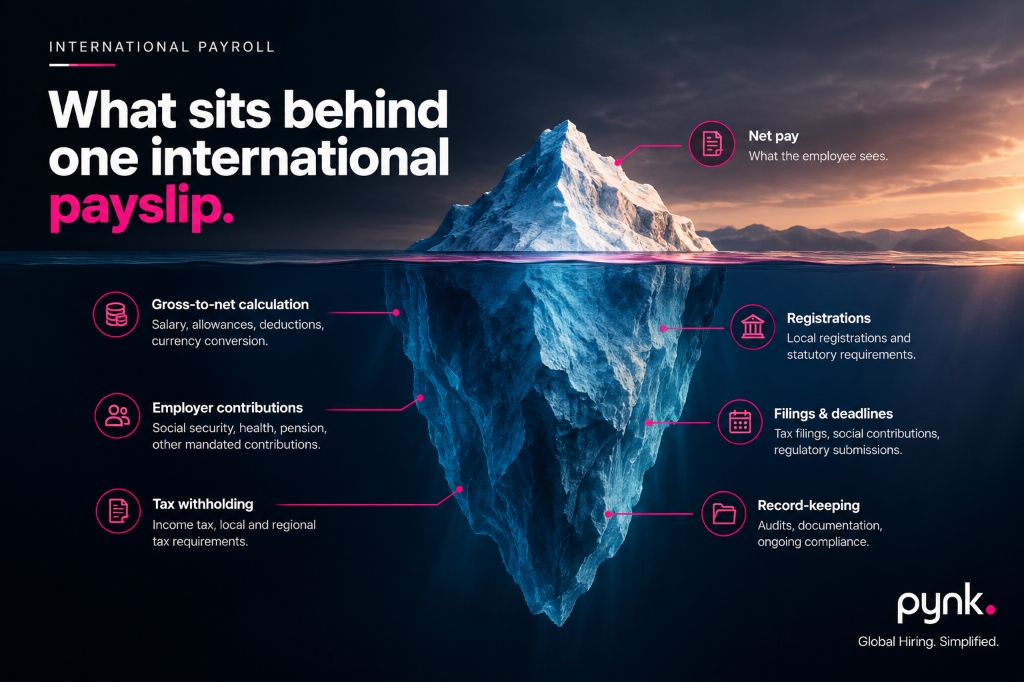
Daniel asked his team to rebuild the picture from the ground up. What does a compliant payroll actually require, in every country? They found eight building blocks, and the problem was hiding in two of them.
1. The right employment structure
Payroll compliance starts before the first payslip. Someone has to be the legal employer, registered in the country. That is either your own local entity or an Employer of Record that employs on your behalf.
2. Registration with local authorities
The employer must be registered with the relevant tax and social security authorities, and each employee must be registered as they join.
3. Accurate gross-to-net calculation
Each pay cycle, gross pay is adjusted for income tax, employee social contributions and other deductions to arrive at net pay.
4. Employer contributions
Employer-side costs, such as social security, pension or insurance contributions, are calculated and paid on top of salary. This is where Daniel’s first problem sat. A change in the contribution base hadn’t been applied.
5. Compliant payslips
Many countries specify what a payslip must contain, and sometimes the language it must be issued in.
6. On-time payments
Employees and authorities must both be paid on time, in the right currency, through reliable channels.
7. Filings and remittances
Monthly, quarterly and annual returns must reach the right authorities by the right deadlines. This was Daniel’s second problem. The salaries were paid, but two filings had slipped through the gap between his finance team and the local accountant.
8. Record-keeping
Payroll records typically must be retained for a set number of years and produced if authorities request them.
The Biggest Payroll and Tax Compliance Risks
Once Daniel started looking, he realized his two issues were small compared to what could have gone wrong. These are the risks that most often turn international payroll into a liability:
- Paying employees without local registration. Sending salaries from abroad without being registered as an employer in the employee’s country can breach local tax and employment rules.
- Permanent establishment risk. Depending on what your employees do and on local and treaty rules, having people working in a country can create a taxable presence for your company there.
- Worker misclassification. Treating employees as contractors to simplify payroll can lead to back taxes, contributions and penalties.
- Missed or late filings. Deadlines are strict, and penalties for late payment or filing can add up quickly.
- Benefits and leave errors. Incorrect accruals for leave, overtime or statutory benefits create liabilities that grow over time.
- Final settlement mistakes. Termination payments, notice pay and accrued entitlements are a common source of disputes.
- Internationally mobile employees. When someone works across borders, tax residency and social security coverage can affect where and how they must be paid.
Wondering what’s hiding in your own payroll? Talk to Pynk about your countries and team structure.
Three Ways to Run International Payroll
Daniel’s real question for the board wasn’t “how do we fix this?” It was “how do we make sure it never happens again?” He put three operating models in front of them:
| Factor | In-house + local advisors | Global payroll provider | Employer of Record |
|---|---|---|---|
| Requires your own entity? | Yes | Yes, typically | No |
| Who is the legal employer? | Your company | Your company | The EOR |
| Who handles compliance? | You, with advisors | Shared: provider processes, you remain the employer | The EOR, for employment and payroll |
| Best for | Large, established local operations | Companies with entities in several countries seeking one consolidated payroll | Companies hiring where they have no entity, or wanting one partner for everything |

The key distinction: a global payroll provider processes payroll for entities you already own, while an Employer of Record employs your team on your behalf and runs payroll as part of that employment. If you don’t have an entity in a country, a global payroll provider alone usually isn’t enough. Our guide to how an Employer of Record works explains this model in detail.
For Daniel, the answer was a mix. In the two countries where his company had entities, a consolidated payroll partner made sense. In the four where it didn’t, an Employer of Record took on the employment and the payroll together.
The Checklist Daniel Now Runs Every Month
Whatever model you choose, the discipline matters. This is the monthly checklist Daniel’s team adopted, and it’s a good starting point for any company:
Before payroll cut-off
- Collect all changes: new hires, leavers, salary changes, bonuses, commissions, expenses and leave
- Confirm that new employees are registered with the relevant authorities
- Check for legislative changes effective this period
During the payroll run
- Calculate gross-to-net pay and employer contributions
- Compare totals with the previous cycle and investigate any unexpected variances
- Obtain internal approval before releasing payments
Payment
- Fund payroll early enough to allow for currency conversion and settlement time
- Pay employees and authorities on or before their due dates
After payroll
- Issue compliant payslips
- File the required returns and remit withholdings
- Reconcile payments against the payroll register
- Archive records in line with local retention rules
Quarterly and annually
- Review upcoming rate and threshold changes
- Complete year-end reporting and employee tax statements
How to Choose a Global Payroll Provider or Payroll Partner
When Daniel evaluated global payroll services and EOR partners, these were the questions that separated strong partners from the rest:
- Do you need an entity? If you don’t have one in a country, you need a partner who can be the employer, not just process payroll.
- Country coverage. Can they support every country you’re in today, and the ones you’ll enter next?
- In-country expertise. Who checks the calculations, and do they understand local rules?
- Accuracy controls. What review steps happen before payroll is released?
- Payment reliability. Can they pay in local currencies, on time, every cycle?
- Regulatory change management. How, and how early, will they tell you about changes that affect your payroll?
- Data security. How is employee data protected, and where is it stored?
- A single point of contact. Will you have one accountable team, or a different contact in every country?
The Board Meeting
Daniel walked into the board meeting with the notice, the root cause, the fix and a new operating model. The issue was resolved within weeks.
The question one board member asked stayed with him: “How would we have known before the notice arrived?” That’s the question every international payroll should be able to answer.
How Pynk Simplifies International Payroll
As your Employer of Record, Pynk employs your team in 160+ countries and runs compliant payroll as part of that employment. Tax withholding, social contributions, filings, payslips and final settlements are all handled for you.
You get a single point of contact and one consolidated view of your international employment costs, instead of a separate vendor, invoice and set of deadlines in every country.
And we believe payroll compliance should be predictive, not reactive. Our focus is on identifying changes in tax and employment rules early, so you hear about them from us, not from a notice.
Planning to expand into the United States? Our complete guide to hiring in the USA covers federal and state requirements step by step.
Frequently Asked Questions
What are international payroll services?
International payroll services cover calculating, paying and reporting employee pay in multiple countries. That includes tax withholding, social contributions, payslips and statutory filings in line with each country’s rules.
What is the difference between global payroll and an Employer of Record?
A global payroll provider runs payroll for entities you own. An Employer of Record legally employs your team in countries where you don’t have an entity and runs payroll as part of that employment.
Do I need a local entity to run payroll in another country?
To run payroll as the employer, you generally need to be registered as an employer in that country, which usually means having a local entity. An Employer of Record removes that requirement because it is already the registered employer.
Can I pay international employees in my own currency?
In many countries, salaries are expected or required to be paid in local currency. Check the local rules for each country before deciding on a payment approach.
What is permanent establishment risk?
Permanent establishment risk is the possibility that your company’s activities in a country, including the work of employees there, create a taxable presence for the company. Whether it applies depends on the activities involved and on local and treaty rules.
How often do payroll and tax rules change?
Frequently. Annual updates to tax rates, contribution rates and thresholds are common, and some countries also introduce changes mid-year.
What does gross-to-net mean in payroll?
Gross-to-net is the calculation that turns an employee’s gross pay into the amount they actually receive. It deducts income tax, employee social contributions and any other mandatory or voluntary deductions, following each country’s rules.
What is shadow payroll?
Shadow payroll is used when an employee working in one country is paid through payroll in another. A “shadow” payroll is run in the host country to calculate and report the taxes due there, even though salary is paid from elsewhere.
Who is responsible for payroll compliance when I use an Employer of Record?
The EOR, as the legal employer, is responsible for running compliant payroll, withholding and paying taxes and contributions, and making the required filings. Your role is to share accurate, timely information about pay changes, bonuses and leave.
What happens if a payroll error is discovered?
It is usually corrected in a following pay cycle, sometimes with amended filings. Depending on the country and the error, interest or penalties may apply, which is why review steps before payroll is released matter so much.
Don’t Wait for the Notice
Tell us where your people are and how you pay them today. Pynk will show you how to bring employment, payroll and tax compliance together under a single point of contact.