
It was 6:40 on a Friday evening when Maya finally found him.
For three months, her company, a fast-growing software business in Singapore, had been searching for a senior engineer who could lead their new data platform. Forty interviews. Two near-misses. And then Tomás: brilliant, thoughtful, and excited about the role.
The offer letter was ready. Maya, the company’s Chief People Officer, forwarded it to the legal team for a final check before sending.
The reply came back in four minutes.
“We can’t send this. Tomás lives in Lisbon. We don’t have a legal entity in Portugal.”
Maya stared at the screen. She had found the right person. She just couldn’t employ him.
Maya and Tomás are fictional, but their situation is one that HR and finance leaders run into every day.
The Three Options That Weren’t Really Options
On Monday morning, Maya sat down with her CFO, Arjun, and laid out what she knew.
They could set up a subsidiary in Portugal. That meant registration, a local bank account, accountants, payroll and months of work, all for one employee. Arjun winced.
They could hire Tomás as a contractor. Fast and simple on paper. But Tomás would work full-time, on their schedule, reporting to their engineering lead. Maya had heard enough stories to know where that could lead.
Or they could let him go.
Arjun leaned back. “There’s a fourth option,” he said. “We use an Employer of Record.”
What Is an Employer of Record?
An Employer of Record (EOR) is an organization that legally employs people on your behalf in a country where you don’t have your own entity.
The EOR becomes Tomás’s employer on paper. It issues a compliant local employment contract, runs payroll, withholds and pays taxes and social contributions, provides statutory benefits, and keeps the employment relationship compliant with local labor law.
Maya’s company stays in charge of everything that matters day to day. They chose Tomás. They define his work, manage his performance and make him part of the team. The EOR carries the legal and administrative responsibilities of being the employer.
The simplest way to think about it: you manage the work; the EOR manages the employment.
How Does an Employer of Record Work? Following Tomás from Offer to Payslip
Here’s what happened next, step by step. Every country has its own rules, but EOR services generally follow the same journey.
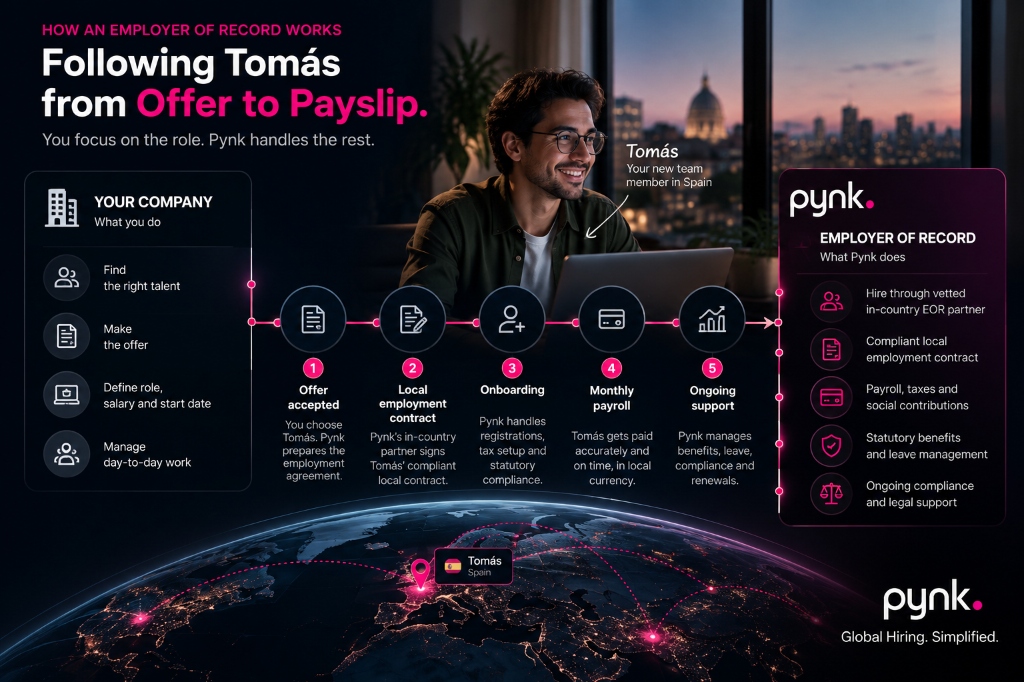
1. The talent is already found
Maya had done the hard part. She agreed the role, salary, start date and key terms with Tomás, just as she would for any hire.
2. A contract that works under local law
The EOR drafted Tomás’s employment contract to meet local requirements: probation, working hours, leave entitlements, notice periods and termination terms. Maya’s legal team checked one thing above all: that the intellectual property Tomás would create belonged to the company, with confidentiality terms that would hold up locally. It did.
3. Onboarding, without the paperwork panic
The EOR collected Tomás’s documents, registered him with the relevant tax and social security authorities and enrolled him in statutory benefits. On his first day, Tomás logged into the team’s Slack like everyone else.
4. The first payslip
At the end of the month, the EOR calculated his gross-to-net pay, withheld income tax and employee contributions, paid the employer contributions, issued his payslip and filed the required returns. Tomás was paid correctly, on time, in local currency.
5. Staying compliant, quietly
Over the following months, local rules changed twice. Maya didn’t have to track either change. The EOR kept the contract, leave, benefits and payroll aligned.
6. If it ever ends
Maya hopes Tomás stays for years. But if the employment ever ends, the EOR manages it under local law: notice, final settlement, statutory payments and documentation.
And for Arjun, the part he liked most: one consolidated invoice covering salary, employer costs and the EOR service. One clear view instead of a stack of local bills.
What Do Employer of Record Services Typically Include?
Most EOR services cover the full employment lifecycle:
- Locally compliant employment contracts
- Employee onboarding and registration with local authorities
- Payroll processing and payslips
- Income tax withholding, social contributions and statutory filings
- Statutory benefits, and supplementary benefits where offered
- Leave and attendance administration
- Ongoing employment compliance and contract amendments
- Compliant offboarding and final settlements
What an EOR doesn’t do is manage your employee’s daily work. Goals, priorities, performance and culture stay with you, exactly as they would for any other team member.
EOR vs. Setting Up an Entity vs. Hiring Contractors
Before they signed anything, Arjun built a simple comparison for the leadership team.
| Factor | Employer of Record | Your own entity | Independent contractors |
|---|---|---|---|
| Time to hire | Fast, once the contract is agreed | Often several months to establish | Fast |
| Upfront setup | None | Significant: registration, banking, accounting, local directors | None |
| Ongoing administration | Handled by the EOR | Your team plus local advisors | Light, but classification must be managed |
| Employment compliance | Managed by the EOR | Fully yours | Misclassification risk sits with you |
| Employee experience | Full local employment and statutory benefits | Full local employment | No employee protections or statutory benefits |
| Best for | Entering new markets, small to mid-sized teams, speed | Large, long-term presence in one country | Genuinely independent, project-based work |
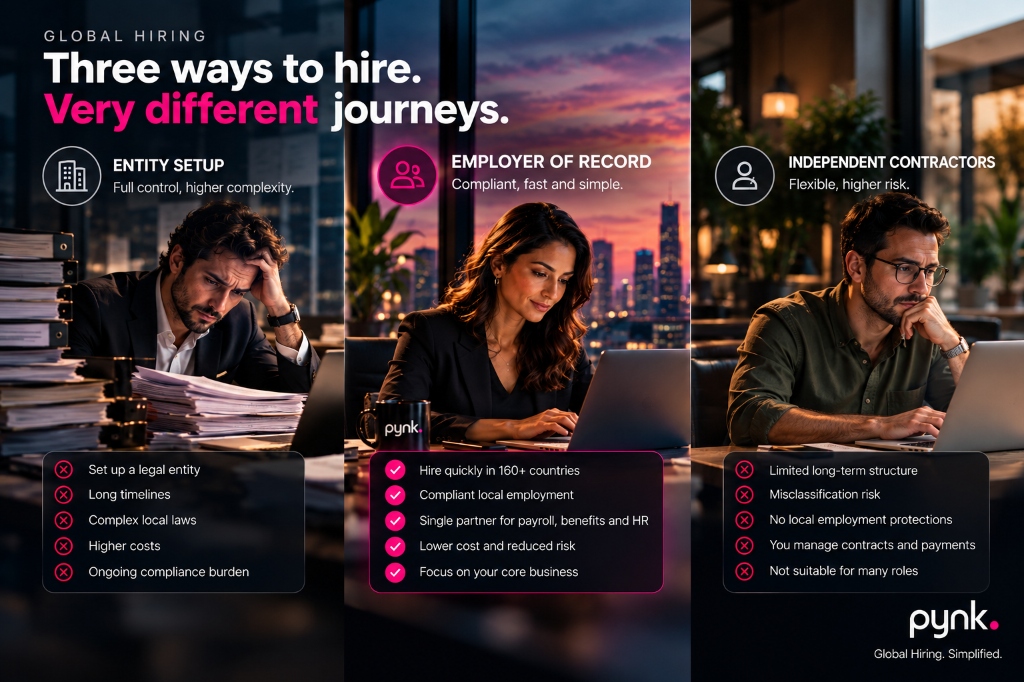
The contractor column was the one that made the CEO pause. In many countries, authorities look at how a relationship actually works, not what the contract calls it. If a “contractor” works fixed hours, reports to your managers and works only for you, they may legally be an employee. The consequences can include back taxes, unpaid social contributions, penalties and employee claims.
Facing a decision like Maya’s? Talk to Pynk and we’ll map out what employing someone in that country involves, before you commit.
When Should You Use an Employer of Record?
Maya’s situation is the classic one. An EOR is usually the right choice when:
- You’re entering a new market and don’t want to commit to an entity yet
- You’re hiring one person, or a small team, in a country
- You’ve found a specific candidate who lives where you have no presence
- You want to convert contractors into compliant employees
- A valued employee is relocating to another country and you want to keep them
- Speed matters and you can’t wait months for an entity to be set up
An EOR may be less suited to building a large, permanent headcount in a single country. Even then, many companies start with an EOR, prove the market, and move to their own entity later. A good EOR partner supports that transition rather than resisting it.
The Objections Maya Heard (and the Answers)
When Maya presented the plan, her leadership team raised the same doubts many companies have about EOR services.
“If we use an EOR, don’t we lose control of Tomás?”
No. The EOR is the legal employer, but Maya’s team directs the work, sets objectives and manages performance.
“Isn’t this only for big enterprises?”
The opposite, often. Startups and growing companies benefit most, because an EOR gives them international reach without the overhead of entities.
“Wouldn’t a contractor agreement be simpler?”
In the short term, maybe. But if the relationship looks like employment, the simplicity disappears quickly, and the risk lands on the company.
“Aren’t all employer of record companies the same?”
They aren’t. Depth of local knowledge, contract quality, payroll accuracy and responsiveness vary widely, and so does how early a provider warns you about changes that affect your people.
How to Choose the Best Employer of Record Services: Maya’s 8 Questions
Not all employer of record companies are built the same. Before choosing an EOR service provider, Maya asked eight questions. They’re worth stealing.
- Coverage and local depth. Do they cover the countries we need now and the ones we’ll need next, with genuine local expertise?
- Compliance approach. Do they react to problems, or tell us about regulatory changes before they affect our team?
- Contract quality and IP protection. Are intellectual property and confidentiality provisions enforceable under local law?
- Payroll accuracy and payment reliability. Will our people be paid correctly, on time, in local currency, every cycle?
- Transparency. Is it clear what’s included and what isn’t, with no surprise line items on the invoice?
- Employee experience. Will onboarding be smooth, with clear payslips and responsive support?
- A single point of contact. Will we deal with one accountable team across every country, or a patchwork of vendors?
- Offboarding expertise. Can they handle terminations and final settlements correctly? This is where mistakes are most expensive.
The best employer of record services are the ones that let you stop worrying about employment administration and get back to building your team.
Six Weeks Later
Tomás started on a Monday. By Wednesday, he had shipped his first change. By the end of the quarter, he was leading the data platform team Maya had hired him for.
Nobody on that team thinks about which entity employs him. That’s the point.
How Pynk Works as Your Employer of Record
Pynk is a global Employer of Record that helps companies hire talent in 160+ countries without setting up a local entity.
We act as your single point of contact for the entire employment relationship: compliant contracts, onboarding, payroll, tax, benefits, compliance and offboarding. Your team works with one partner, not a different vendor in every country.
Our approach is built on a simple idea: move from reactive to predictive. Instead of waiting for compliance issues to surface, we focus on spotting regulatory and employment changes early, so you can plan for them rather than scramble.
As your international team grows, payroll becomes the next challenge. Our guide to managing international payroll and tax compliance shows what to watch for. And if the US is on your roadmap, read our complete guide on how to hire employees in the USA.
Frequently Asked Questions
Is using an Employer of Record legal?
Yes. The EOR model is widely used and recognized around the world. The specific rules vary by country, and a small number of countries place limits on how such arrangements can be used, which is why local expertise matters.
Who owns the intellectual property created by an EOR employee?
The employment contract should assign intellectual property created in the course of the work to your company. Always confirm that your EOR’s contracts include IP assignment provisions that are enforceable locally.
How long does it take to hire through an EOR?
It depends on the country and on the candidate’s notice period with their current employer. In most cases it is much faster than establishing your own entity, because the legal and payroll infrastructure is already in place.
What is the difference between an EOR and a PEO?
A Professional Employer Organization (PEO) typically works under a co-employment model and usually requires you to have your own entity in the country. An EOR is the legal employer, so no entity of your own is needed.
Can I convert contractors into employees through an EOR?
Yes. Converting contractors into employees through an EOR is a common way to reduce misclassification risk while keeping the people you already work with.
Can I move from an EOR to my own entity later?
Yes. Many companies use an EOR to enter a market and transfer employees to their own entity once headcount justifies it. A good EOR partner helps plan that transition.
How much do employer of record services cost?
EOR costs usually combine three elements: the employee’s salary, the employer’s statutory costs in that country (such as social contributions), and the EOR’s service fee. Because statutory costs vary widely by country, it’s worth getting a country-specific breakdown before you make an offer.
Is an EOR the same as a staffing agency?
No. A staffing agency finds and supplies workers. With an EOR, you choose the person yourself and manage their work; the EOR only takes on the legal employment, payroll and compliance.
Will my employee know they are employed through an EOR?
Yes. Their employment contract is with the EOR, and that’s explained during hiring. Day to day, they work as a full member of your team, with your tools, your managers and your culture.
What happens if we stop using the EOR?
You have options. Employees can transfer to your own entity, move to another provider, or, if the role ends, be offboarded in line with local law. Plan any change early so employees experience a smooth transition.
Found Your Tomás?
Tell us where your candidate lives and the role you want them in. Pynk will walk you through the employment, payroll and compliance requirements for that country, and manage everything from contract to payslip.