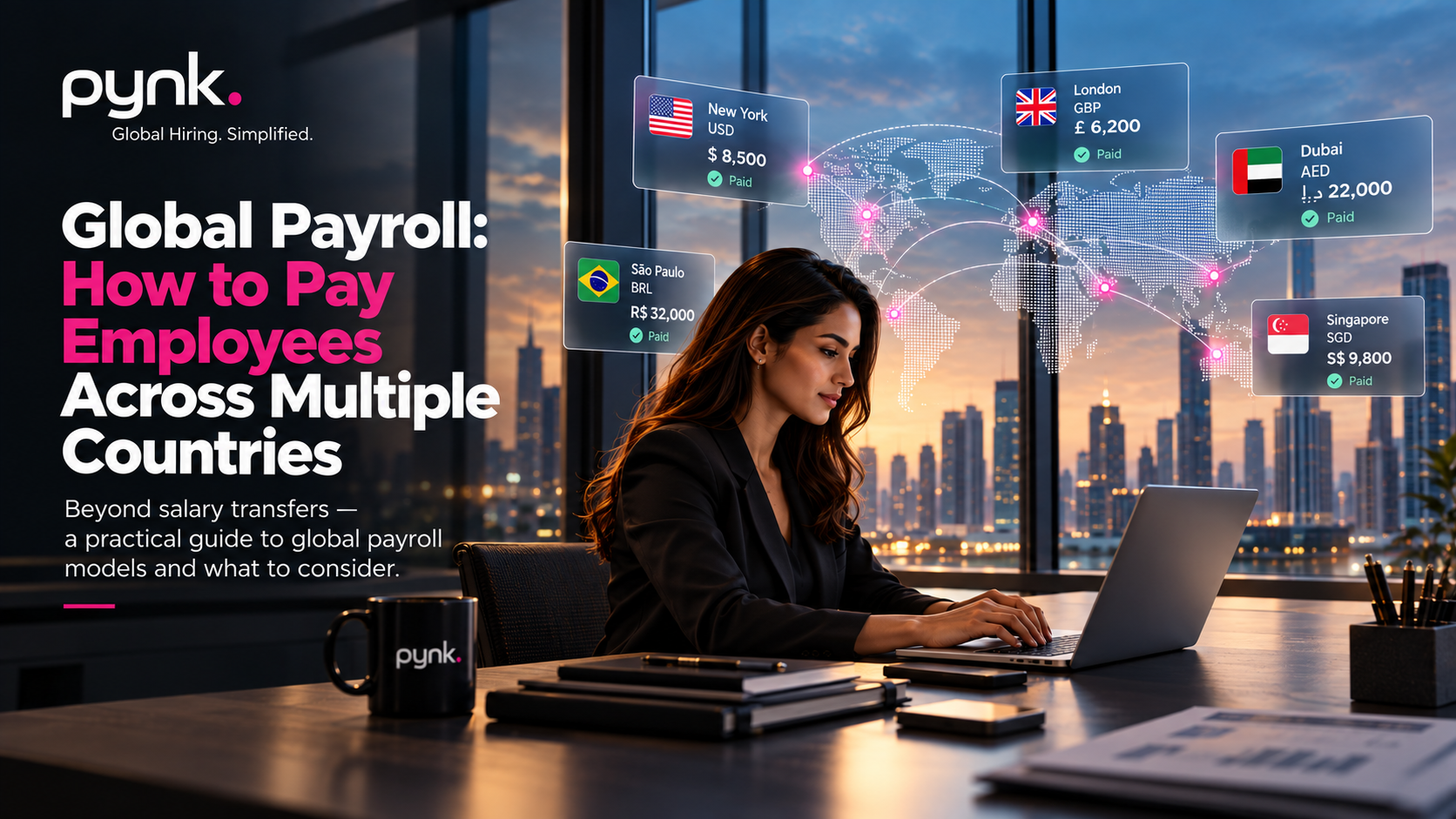
Paying employees abroad is more than sending money
Imagine your company has employees in four countries.
Each market may have its own currency, payroll calendar, deductions, employer contributions, reporting requirements and payment deadlines.
Then an employee asks:
“When will I be paid, and will everything be handled correctly?”
That is where international payroll becomes more complex.
But there is an important question that comes before payroll:
Who legally employs the person?
That answer determines which payroll or employment model may be appropriate.
Why global payroll is different
International payroll can involve:
Different currencies and pay schedules
You may need to manage currency conversion, payment timing, bank routing, cut-off dates, exchange-rate movement and local holidays.
Different statutory deductions and contributions
Taxes, social security, insurance and employer contributions can vary by country and employee circumstances.
Local reporting
Some countries require payroll-related information to be reported to authorities on specific schedules and in specific formats.
Benefits and statutory pay
Local payroll may need to account for mandatory leave pay, bonuses, allowances, insurance or other employment-related amounts.
The process cannot simply be copied from one country to another.
Payroll and employment are two different questions
This distinction is important:
- How do we legally employ this person?
- How do we calculate and pay what is owed?
Payroll addresses the second question. It does not automatically solve the first.
A payroll provider or payroll platform can support pay administration for employees already legally employed through the appropriate structure. It does not, by itself, create that legal employment relationship.
Pynk is an EOR, not a standalone payroll provider. Payroll-related administration is part of the broader employment relationship where applicable.
Three common models
1. Payroll for an existing legal entity
If your company already has the appropriate entity in a country, a payroll provider may help with:
- Payroll calculations
- Payroll calendars
- Reporting
- Payment files
- Pay statements
- Payroll data management
This supports payroll operations but does not replace the legal-employment structure.
2. Payroll through your own foreign entity
A company can establish an entity and manage payroll through it, internally or with a local partner.
This can make sense for larger, long-term operations, but it also means taking responsibility for entity setup, employment compliance, reporting, contributions and ongoing administration.
3. EOR-managed employment
With an EOR, the EOR is the local legal employer, subject to the country and arrangement.
Payroll-related activity, statutory deductions, employer contributions and benefits administration can form part of the broader EOR-managed employment service.
This can be useful when a business wants to hire in a country where it does not have its own entity.
Which model is right for you?
Consider:
- Do we already have a legal entity?
- Are the employees already legally employed?
- Are we hiring one person or building a larger team?
- How long will we operate in the market?
- How much local administration can we manage?
- Who is responsible for statutory filings and contributions?
- Do we need payroll support or a complete employment solution?
A company may use different models in different countries depending on its structure and hiring plans.
What good global payroll management should clarify
Before choosing a provider, understand:
What is included: payroll calculations, payment coordination, deductions, contributions, reporting, pay statements and benefits-related administration.
What is not included: legal employment, entity setup, immigration, employment advice or worker-classification decisions, unless specifically stated.
Who is responsible: the client and provider should have clearly documented responsibilities.
Do not assume that two providers offering “global payroll” are solving the same problem.
Before the first payroll run
Confirm:
- Where the employee is legally employed
- Who the legal employer is
- Local currency and pay schedule
- Employer contributions and employee deductions
- Required reporting
- Mandatory benefits and pay elements
- Payment cut-off dates
- Responsibility for errors or missed filings
- How salary, role or location changes are handled
- What happens when employment ends
Pynk Perspective
Pynk is an Employer of Record. We are not a standalone global payroll provider, payroll platform, payroll processor or payroll software company.
Where pay administration is required, it forms part of the broader employment relationship we help manage, depending on the country and arrangement. This may include documentation, statutory obligations, benefits, employee administration, support, changes and offboarding.
The right first question is:
“Do we only need payroll processing for people we already employ, or do we need a legal employment solution for someone in a country where we have no entity?”
That distinction can prevent businesses from choosing a payroll solution when the real requirement is an employment model.
Final takeaway
International payroll is not one universal process. The right approach depends on where employees work, who legally employs them, how many people you have and how much responsibility your business wants to carry.
If you are hiring in a country where you do not have your own entity, Pynk can help you evaluate the EOR route.
Talk to Pynk About Global Employment — or Explore Pynk EOR Services.
Pynk | Global Hiring. Simplified.
This article is for general informational purposes only and should not be treated as legal, tax, payroll or employment advice. Requirements vary by country, employee circumstances and employment arrangement. Businesses should obtain appropriate professional advice before making a decision.